Not quite a quarterly update, and I realized that I did not post about my goals here, on my blog. So, let’s start by sharing my goals and how they are going now that we are a third way through the year.
Solo Show Goals:
Finish All 10-11 Pieces
COMPLETED
Enjoy the experience which means for me accept that the residency was for experimentation not perfection
COMPLETED
Set-up a couple of Studio Visits
Had 1 Studio Visit
Overall, my solo show went really well. Two of my three events had great attendance and participation. I loved how all the pieces came together in the space.
I did also have some other art goals I would like to accomplish this year. So far things are going really well. Here’s how they are tracking :
Exhibit in a Museum
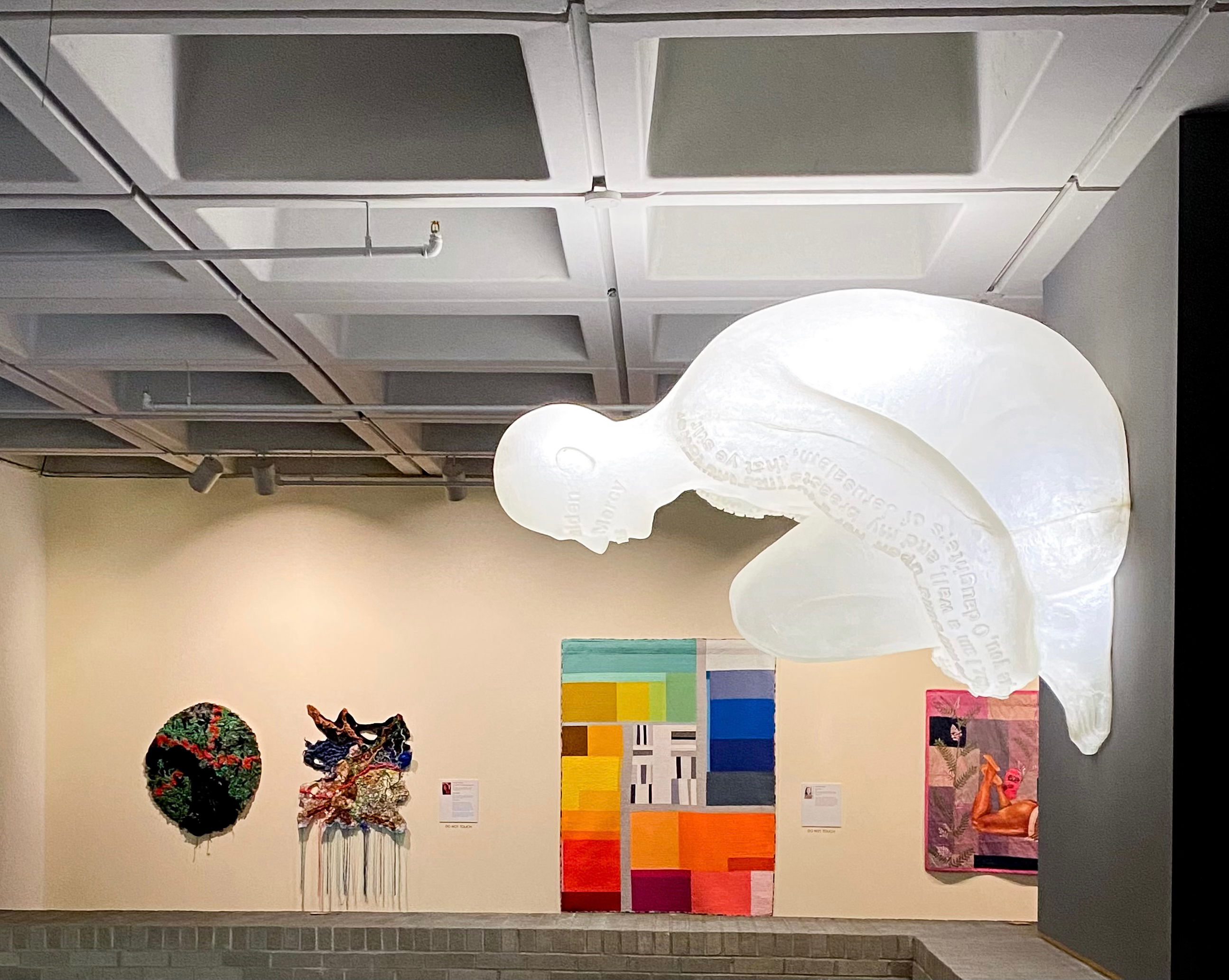
COMPLETED (See my piece through July at NC Museum of Art)
Working on exhibiting outside of NC via art institutions (already exhibit outside of NC for quilts events)
– Artfields, SC (Ford + Son); 26 April – 4 May 2024 – Solo Exhibition “Eyes Wide Open”, Petersburg, VA; 14 June – 3 August 2024
Find a Artist Studio in the triangle
COMPLETED – Have a studio at ArtSpace!!
Keep putting myself out there and be open for opportunities
See application updates below
Continue to meet new people/support artist I’ve met in my local community
ON-GOING
Finanicial Goals – Cover expenses ~$20,000
3/4 of goal and expenses are covered
Be represented by a Gallery or work with Art Consultants
Not followed through yet
Applications have been surprisingly successful. Here are the ones I have applied too so far this year.
Artist in Residence
Residency Program
Works Submitted
Result
Cost
Calendar
Ox-Bow Summer Artist in Residence
Colosseum, Ford+Son, Rails II, Walled, Broken Trellis, Aroha, Home, Study No. 3, New York Highline, City Bustle
Accepted
NA
26 May – !5 June 2024
Exhibitions/ Shows
Applied for Shows
Works Submitted
Result
Cost of Submission
Calendar
Solo Exhibition – Eyes Wide Open
20 – 24 pieces
Accepted
NA
Petersburg, VA 14 June – 3 August 2024
Coined in the South
Rails II, Colosseum, Crack of Light
TBD (06/28)
$40
Installation Dates: August 1, 2024 – Nov 1, 2024 Exhibition dates: December 14, 2024 to April 27, 2025
Durham Art Guild Members Show
COVID Mash-up
non-juried
$0
June 14 – July 29, 2024
Sisters Outdoor Quilt Show
Broken Trellis, Rails II
Teacher’s Exhibition
$0
July 13th
PIQF
Rails II
TBD (06/21)
$40
Pacific International Quilt Festival, July 24 – 27, 2024
Fellowships and Grants
Name
Result
Cost
South Arts Fellowship
Declined
$25
Hopper Prize
TBD
$35
This year, I also wanted to include health goals as these tend to be the last ones I accomplish. Overall, these are going better than past years but I still have to work on consistency.
Loose weight ~40 pounds
Doing well, DOWN 17 pounds
Start Walking Regularly
Working on consistency
Set-up Monthly Photography outings for getting out and walking
– Set up a 30 day challenge that I’m doing now (struggling for every day) – Plan on 2-3 outings for June in MI and 2 weeks for vacation in OR in July
Make all my screenings
Still to Organize
I am so thankful for all the things that have come to fruition and excited for the things to come. I have some larger goals I want to accomplish but I’m still working through what those look like.
Right now, I want to give myself some space to experiment and play with some ideas and see where that leads. More to come.
My time with the Durham Art Guild (DAG), as an artist in residence (AiR) has come to an end. It was bittersweet, excited about the new opportunities in front of me (more to come) but sad I won’t see everyone as often. I can highly recommend this 6-month (ish) artist in residence. I got so much out of it.
DAG Studio Space at Durham Bottling Company
I learned a lot about myself through this residence, which could be in part due to the fact I had a lot to learn about being a full-time artist for the first time in my life. Things I learned about myself:
I am scheduled driven person. Once I left corporate I thought I would never need scheduled meeting requests have my daily life ruled by planned activities. I was so wrong. I need all my meetings in my outlook calendar or I forget. I also need a weekly planner. I have much better focus and also tend to accomplish things with a weekly plan. It is really just a list for me, broken into three parts – Things I want to get done this week (art, business or home activities), stretch goals (activities I would love to do if I have extra time) and lastly things carried over from the previous week which have highest priority.
I enjoy working in a studio whether at home or outside the home. It is harder to have two spaces though, as you either need two of everything or you need to know what you need to bring with you depending on what you are working on.
As an introvert, I still find it hard to talk about my art but its easier if I take someone with me especially someone that will help promote my work.
I’m ok at administration tasks but terrible at the accounting side of my business (as in collecting receipts, mileage, and taxes etc. )
I need community and access within a future studio space outside my house. If I don’t get those things in a studio space, I can work from home.
I am terrible about asking for help but I learned when asked not to always jump to “I’m OK” and take time to think about items where I didn’t need to complete them on my own.
I got a lot out of hanging work I might now have shown if I had more time or I wasn’t restricted to only new work for the show. There was a lot of positive feedback and folks connecting to those pieces I wasn’t sure about. Seeing all the pieces together and hung also gave me a different perspective which let me accept all the pieces.
Fellow AiR (L-R): Delayna Robbins, me, Sanjé James, and Mentor Isabel Lu
Photo: Danny Peña ( IG: @pen_yah)
The residency not only gave me insights into myself but also provide me:
A close group of people who were my fellow AiR, DAG staff and also, our mentors in the program who I would consider friends. This was the best part of the residency. I cherish the friendships made.
Networking opportunities. I tried to attend and submit to every event DAG provided or shared. With this I met some more wonderful people, that I need to know in the art community, and other wonderful artists who I can converse with and learn from.
New Opportunities like First Christmas Market, First Critique, Second Solo Exhibition and more.
Opportunity to experiment and produce new work for 6-8 months.
Studio Space outside the house for free was invaluable, especially to work out what I need in a studio space if I was to pay for one outside my house.
Provided me additional skills in organizing a solo exhibition. Check out my checklist for a show.
Part of my Solo Exhibition Space
Photo: Danny Peña ( IG: @pen_yah)
There are things I wish I had known before or within the first month of the residence and things I would change:
I might have missed this originally or it didn’t sink in….The solo show was going to consist of just new work created during the 6-8 month residence. For me, this meant experimenting was really limited to the first two months, as I needed to start finishing things for the show. It worked out for the space 6-8 new pieces were needed for the gallery. I actually wish the residency could be longer to get more time to experiment.
A guide on what is needed for a successful solo show. Activities list, I should look at and dates in which I should have these completed.
Other than that, the experience is amazing, something every artist should get a chance to experience (especially as an emerging artist).
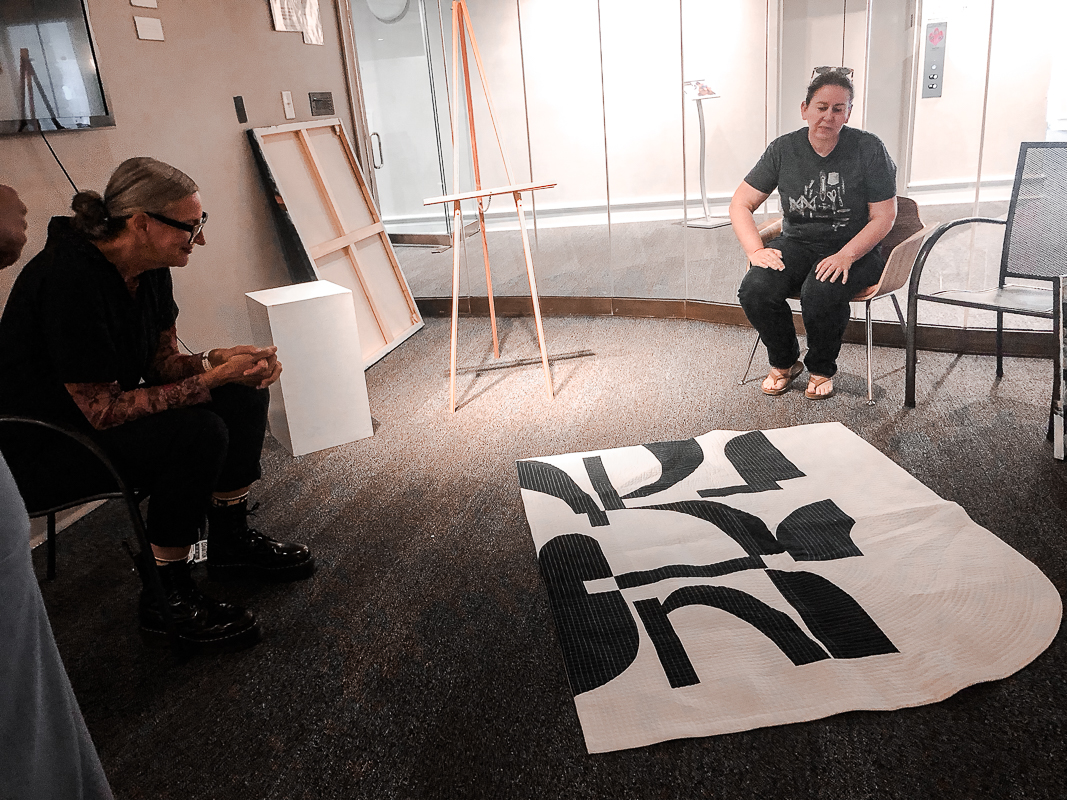
DAG Critique
Photo: Jacqueline Dulin (IG: @significantform)
If you are interested, the 2024 -2025 program (July – December with a show in 2025) is currently open for applications. You can apply here by 1st May 2024.
Sorry for the delay in this post. The last quarter of 2022 was so busy as I was transitioning my out of my job and the company I worked for, for 24 years. Also, in December I got to go Morocco and came back from traveling with COVID. It was a very interesting year end.
Just a reminder, this is what I have found or done on my journey moving from being a quilter to a textile artist. This may or may not be the best path for you. Let’s talk about how to get into an exhibition and where to start.
Where do I start?
I have found most galleries will have a call to entry. This could be for a curated exhibition (themed or a group exhibition) with multiple people participating or it could be a call for a solo exhibition – all the pieces will come from one person.
I do multiple things to keep an eye out for the call for entries:
Follow places I am interested in exhibiting at on social media and sign-up to their newsletters if they have one. I tend to do this with places that are local to me, for example: Artspace NC, Cam Raleigh, McColl Center, and 311 Gallery.
Join groups that have exhibitions regularly and/or post other opportunities. Here are examples of some local places to me Durham Art Guild, Fine Arts League of Cary and some inter/national groups such as SAQA, Surface Design Associates, Fiber Art Now.
Sign-up for sites that post Call of Entries for galleries, shows and other companies. The most common one I found was Cafè (note it is not specific to quilts but provide a lot of opportunities for art shows….after all Quilts = Art).
In Preparation for Submission
In preparation, for submitting your quilts to a call for entry, here are the things I have on hand just in case. These can be daunting at first but once you have them prepared it is much easier.
Artist Bio (biography): This is a description, in the third person, about me. I keep bio to ~200 words and at times I will have to cut it down to 100 words. This should cover the artist career highlights, and a summary of their work to the present day. If you have been formally trained then also include education.
Artist Statement: An artist statement is usually a statement that accompanies a selection of new art and explains the artist’s process and motivation as they created those artworks.This can be different depending on what you are applying for. If you are submitting a specific piece you would talk about that piece. If you are submitting for a solo exhibition it would be about the theme and goal of the your pieces that go into that exhibition.
Resume: You may be asked to submit a resume which should include what you have done as an artist such as previous exhibitions/shows (include your quilt shows too), also include other things you have done as an artist. I include publications, teaching, and volunteer activities. It should not be longer than two pages. Depending on what I am applying for I change these categories around, since we are talking about exhibits here make sure that is at the top.
Like other quilt shows, also have available, material used in quilt, date finished, name of art piece, dimensions, and amount you are willing to sell it for. You may want to have a list prepared and stored in a document so it is editable and easy to copy.
Have you photo images ready. I have found that the images of your quilt must be flat and on a white background and usually a high quality image. If selected they may use this image for the exhibit marketing materials. You may need also a detail shot but this is less likely for an art exhibition.
You may never have written an artist statement before or created an artist statement, best advice I can give you is to take a look at other artists, ones that are similar to you and ones that are not. What did you like and not like and style yours based on that.
Applying for a Call For Entry
It is important to read the instructions and any additional details they provide. These instructions will let you know:
if there are any restrictions (like size, or if they are looking for specific theme or a focus that excludes your medium) or
the selection process (judging and dates for announcements and delivery of your piece) or
the piece must be sellable and how much the gallery will keep vs. how much you will receive.
Hanging instructions, you may need it “ready to hang” includes wire etc.
Most call for entries will have a fee.
Exhibitions may have prize money.
If you are applying for a solo show, make sure you read the fine print on the photos you submit. They will either ask for x number of photos of the art pieces (quilts) you will be showing (and you must show these quilts with substitutions if you have to but it is usually of a similar piece) or you will be asked to submit a “portfolio” of your work that matches the Artist Statement you submit. In this case, they don’t have to be the exact pieces for the final show.
Important, I save all images and documents for each call for entry in its own folder, even if that means I duplicate things. This way you have a record of what you submitted in case you need to validate down the line. I also keep a spread sheet with the following information: Name of quilt, date made, size, link to artist statement for the one piece, submission/call for entry, date of deadline, date of announcement, date to ship by, Accepted or not, shipped (Y/N), Date of shipped, expected date of return and other notes of importance.
Additional Information for Solo Exhibition
In my experience (accepted for my first solo exhibition), once selected for a solo exhibition the process differs slightly.
You may have to sign a contract committing to dates and space, opening reception, hanging and takedown dates and times etc.
You may or may not sell your work. If you sell your work again the gallery will take a commission so consider that in your prices. If you aren’t allowed to sell your work ask if you can provide a flyer or information at the door for with contact information (or even prices).
Ask for the layout of the Gallery, wall and floor space. Get the dimensions of where you can hang work and what size you can use in each space. Consider windows, doors or other non-useable space.
Ask about what will be available to hang with and what is allowed.
Make sure you organize folks to help hang and take down the show if it is your responsibility.
Art Exhibition vs. Quilt Show
There are similarities and differences between the submission process for a quilt show vs. an exhibit. Here is a list to see some differences:
Exhibit Process
Quilt Show Process
Eligibility
Rules and guidelines
Instructions for Call for Entry
Instructions for submission
Photo full view (High quality, white background, photo must meet size and naming requirements)
Photo full view (High quality, white background, photo must meet size and naming requirements)
N/A
Photo detail view (High quality, white background, meeting size and naming requirements)
Artist Statement (description of solo show/ or single piece submission; possibly in a separate document)
Description of Quilt (typically within submission)
Year made
Year made
Artist Biography (separate document)
N/A
Sellable (typical, and gallery will take commission 30 or higher is possible)
Choice between Sellable or not for sale (NFS)
Curated (usually the curator will be announced in the call for entry)
Juried into the show and then Judged.
Above is the most common processes and expectations I have seen but this may vary if it is an online show vs. in-person, or if the exhibit is an open call where everyone will have a piece accepted but typically there is another process where a curator will choose top pieces or a smaller exhibition that will follow-on.
I am happy to share any of the documents, I mention above, if you are interested. Let me know if you have any questions.











 Factotum of Arts